

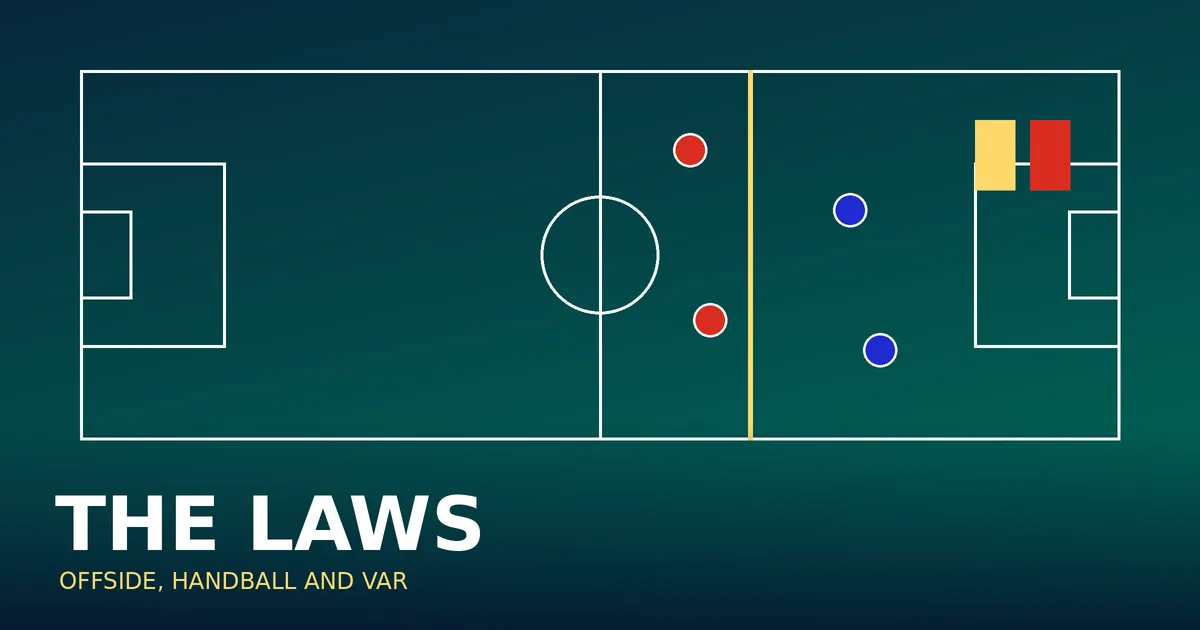
Every football argument eventually becomes an argument about the rules. Was it offside? Was it handball? Why did the referee check the screen? The laws of the game are short, but they have a long history and a few tricky ideas.
This guide explains who writes the laws, how they changed over time, and how the most debated rules work in everyday language. It is written for fans, young players, parents and anyone who has ever shouted at a television.
Who writes the laws of football?
The laws are written by the International Football Association Board, known as IFAB. It was founded in 1886 by the football associations of England, Scotland, Wales and Ireland, which wanted one shared rulebook. FIFA joined in 1913. Today IFAB has eight voting members: the four British associations have one vote each, and FIFA has four votes. A change needs at least six of the eight votes, which means FIFA cannot change the laws without British support, and the British associations cannot change them without FIFA.
IFAB meets every year to decide on changes, and the updated Laws of the Game are published before the new season. There are 17 laws in total, covering everything from the field of play and the ball to fouls, offside and penalties.
How the laws have changed
The first laws, adopted in 1863, had 13 rules and no crossbar, only a tape between the posts. Over the next 160 years, the game was shaped one problem at a time. Here are some of the most important changes.
- 1871: The goalkeeper is recognised as a special position and allowed to handle the ball.
- 1872: The corner kick is introduced.
- 1878: The referee’s whistle is used in a match for the first time.
- 1891: The penalty kick is introduced, an idea credited to an Irish goalkeeper named William McCrum. Goal nets also arrive around this time.
- 1925: The offside law is changed so that an attacker needs two opponents, rather than three, between him and the goal line. Goals increased sharply afterwards.
- 1970: Yellow and red cards are used at the World Cup for the first time. Substitutes are allowed at the World Cup for the first time as well.
- 1992: The back-pass rule stops goalkeepers from picking up deliberate passes from teammates’ feet.
- 2012: Goal-line technology is approved. VAR is approved in 2018 and used at the World Cup that year.
- 2020 to 2022: Five substitutions are allowed in a match, first as a temporary measure and later as a lasting option.
The idea for yellow and red cards came from English referee Ken Aston, who thought of traffic lights while driving after a confusing World Cup match in 1966.
Offside explained
Offside is the most misunderstood law in football. It exists to stop attackers from simply waiting near the opponent’s goal for a long pass. The key points are below.
- A player is in an offside position if any part of their head, body or legs is nearer to the opponents’ goal line than both the ball and the second-last opponent. The goalkeeper counts as an opponent, so usually the second-last opponent is the last outfield defender.
- Being in an offside position is not an offence on its own. A player is only penalised if they become involved in play, for example by receiving the ball, interfering with an opponent or gaining an advantage.
- The moment that matters is when the ball is played by a teammate, not when the attacker receives it.
- A player level with the second-last defender is onside.
- You cannot be offside in your own half.
- You cannot be offside directly from a goal kick, a throw-in or a corner kick.
For beginners, the simplest rule of thumb is this: if you are ahead of the ball and ahead of the second-last defender when your teammate passes, you are in an offside position.
Handball explained
Handball is not simply “the ball hit a hand”. The law looks at what the player did with their arm. Referees generally consider whether the player moved their hand towards the ball on purpose, whether their arm made the body unnaturally bigger, and whether the arm was in a position that is expected for what the player was doing at that moment, such as running or jumping.
- A deliberate touch with the hand or arm is an offence.
- An arm held away from the body so that the body becomes unnaturally bigger can be an offence, even if the touch was not planned.
- A ball that comes off the player’s own head or body, or off a nearby teammate, and hits a close arm is judged more leniently.
- A goalkeeper can use their hands inside their own penalty area, but not for a deliberate back-pass from a teammate’s foot.
The rules about accidental handball by an attacker before a goal have been adjusted more than once in recent years, so the best way to follow a current match is to check the most recent version of the Laws on the IFAB website.
Fouls, penalties and cards
A foul is an unfair act in play, such as a reckless tackle, pushing, tripping or holding. Fouls lead to free kicks, and a foul by a defender inside their own penalty area leads to a penalty kick. The referee uses cards to control behaviour.
- Yellow card (caution): for reckless play, time-wasting, dissent or similar offences. Two yellow cards in one match become a red card.
- Red card (sending off): for serious foul play, violent conduct, spitting, denying an obvious goal-scoring opportunity by a deliberate foul or handball, or using offensive language.
The referee can also play “advantage”, which means letting play continue if the team that was fouled is still in a good position. If the advantage does not come, the referee can go back and give the foul.
How VAR works
Video assistant referees, known as VAR, were added to the laws in 2018. VAR does not decide matches by itself. A team of officials watches the game on screens and can only recommend a review in four types of situation.
- Goals, including possible fouls, handballs or offside in the build-up.
- Penalty decisions, both given and not given.
- Direct red card incidents, but not second yellow cards.
- Mistaken identity, when the referee cautions or sends off the wrong player.
The guiding idea is that VAR should only step in for a “clear and obvious error”. If the referee wants a second look, he or she can go to a pitchside monitor. In recent years, semi-automated offside technology, which uses cameras and a sensor in the ball, has been used to speed up offside checks at major tournaments.
Many fans still complain about delays and inconsistency. Those are real concerns, and football’s lawmakers keep adjusting the process. What VAR has done is reduce the number of obvious mistakes that decide big matches.
A quick guide to how play restarts
- Kick-off: starts each half and restarts play after a goal.
- Goal kick: awarded when the attacking team last touched the ball before it crossed the goal line.
- Corner kick: awarded when the defending team last touched it before it crossed their own goal line.
- Throw-in: awarded when the ball crosses the touchline, to the team that did not touch it last.
- Direct free kick: for most fouls, and a player can score straight from it.
- Indirect free kick: for technical offences and some others, and a second player must touch the ball before a goal can count.
- Penalty kick: for a foul by a defender inside their own penalty area.
Key takeaways
- The laws are written by IFAB, which has been made up of the four British associations and FIFA since 1913.
- There are 17 laws, and they change a little every year.
- Offside depends on where the second-last defender and the ball are when the pass is made.
- Handball depends on the player’s actions and whether the arm made the body unnaturally bigger.
- VAR reviews only goals, penalties, direct red cards and mistaken identity.
Frequently asked questions
Can a player be offside from a throw-in?
No. A player cannot be offside directly from a goal kick, a throw-in or a corner kick. The player can still be offside later in the same phase of play.
What is the difference between a direct and an indirect free kick?
A direct free kick can go straight into the goal. An indirect free kick needs another player to touch the ball before a goal can count.
Does VAR check every decision?
No. VAR only looks at goals, penalty decisions, direct red cards and cases of mistaken identity, and it only recommends a review when it believes there was a clear and obvious error.
Why did the laws change in 1925?
Before 1925, an attacker needed three opponents between him and the goal line when the ball was played. Defenders became expert at catching attackers offside, matches had fewer goals, and the law was changed to two opponents. Goals rose sharply, and teams had to invent new defensive systems.
Keep reading
About this article. Written by the Blessed Records Exclusive Entertainment editorial team from published football history and official records. The images are original illustrations made for this site. We update our guides when facts change. If you spot a mistake, please contact us and we will check it.