

For more than a century, football resisted technology. Referees made decisions on the spot, and mistakes were part of the game. Over the last decade that has changed. Cameras, sensors and data now influence decisions on the pitch, the way teams train and even how fans watch matches.
This guide explains the main technologies in plain language, when they arrived, how they work and why people still argue about them.
Goal-line technology
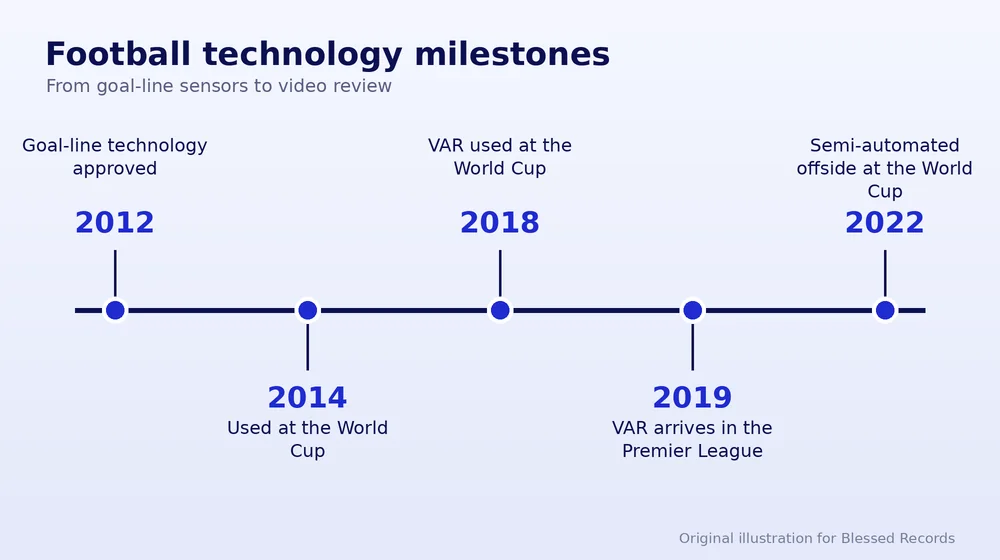
The first major change was goal-line technology, which tells the referee within a second if the whole ball has crossed the line. It became necessary after famous incidents in which the ball was clearly over the line but not given. IFAB approved the technology in 2012. Systems use high-speed cameras or magnetic fields. The Premier League began using it in 2013 to 2014, and the 2014 World Cup was the first World Cup to use it. When the ball crosses the line, a signal is sent to the referee’s watch within a second.
Video Assistant Referees
VAR was tested in 2016, and its first major use in a competition was the FIFA Club World Cup in December 2016. After trials in several leagues, IFAB approved it as a permanent part of the laws in March 2018, and it was used at the 2018 World Cup in Russia. The Premier League introduced it for the 2019 to 2020 season.
Here is how it works. A team of video officials, based in a central room, watches the game on many camera angles. They can only recommend a review for four types of decision: goals, penalties, direct red cards and mistaken identity. If the referee wants to check, he can walk to a pitchside screen and look at the incident himself.
Semi-automated offside
Offside decisions were the main source of criticism of early VAR, because officials drew lines on screen by hand, which took time. At the 2022 World Cup, FIFA used semi-automated offside technology. Twelve cameras under the stadium roof tracked 29 points on each player’s body, and a sensor inside the match ball told the system exactly when it was kicked. The system could alert the video officials in seconds and show a 3D animation to explain the decision. Several leagues have introduced similar systems since then.
The connected ball
The match ball for the 2022 World Cup, called Al Rihla, had a sensor inside that sent data to officials 500 times a second. It also helped to find the exact moment a pass was made. Sensors in training balls are also used to measure passing speed, spin and accuracy.
Data and analysis
Technology has had an even bigger effect behind the scenes. Companies such as Opta collect data on every pass, shot and tackle, and clubs now hire analysts to turn those numbers into advice.
- Expected goals (xG): A statistic that gives each shot a value between 0 and 1, based on how often shots from that place and situation are scored. A penalty is about 0.76. A shot from 30 metres might be 0.03. Over a season, it helps show whether a team is creating good chances.
- Heat maps: Pictures showing where a player spent time on the pitch.
- Tracking data: Cameras record the position of every player many times each second, which lets coaches study running distances, speed and spacing.
- GPS vests: Small devices worn by players in training to measure how much they have run and how hard.
- Scouting platforms: Online databases of video and statistics that allow clubs to find players around the world, including in Africa and South America.
Health and safety technology
Technology also protects players. Teams use sports science to manage training loads and reduce injuries. Medical staff use heart screening to detect problems in young players and concussion protocols to remove players who may have a head injury. After many discussions, football’s lawmakers allowed extra substitutes in cases of suspected concussion so that teams do not lose an advantage by making a safe decision.
Technology for fans
Fans benefit too. Matches are streamed live on phones, and apps give instant statistics, replays and alerts. Clubs sell digital tickets, use facial-recognition or ID systems in some countries to improve stadium security, and offer virtual reality and online communities. Broadcasters use extra cameras, drone footage and augmented reality graphics. In Nigeria and across Africa, mobile data has made it possible to follow Premier League and Champions League matches on a phone from almost anywhere.
The arguments about technology
- Delays: Reviews can slow the game and interrupt goal celebrations.
- Consistency: Fans often complain that similar incidents lead to different decisions.
- Clear and obvious error: VAR is meant to correct clear mistakes, not to re-referee everything, but people disagree about what counts as clear.
- Cost: Systems are expensive, so leagues in poorer countries often cannot afford them. That creates a gap between the richest competitions and everyone else.
Technology in Africa and smaller leagues
Technology costs money, so the gap between rich and poor leagues is real. The Africa Cup of Nations used VAR in the knockout rounds in 2019, and several African competitions have introduced it since then, but many domestic leagues still cannot afford the cameras and trained staff it needs. Some clubs use simple tools instead, such as a phone or camera on a tripod to record matches, free software to count passes and shots, and group chats for coaches to share clips. A club does not need a huge budget to start using video and statistics to improve.
Technology and referees
Referees now use technology in other ways, too. They have headsets so that they can speak to the video team, watches that vibrate when the ball crosses the line, and fitness trackers to measure their running. At recent tournaments, officials have also explained major decisions to the crowd through stadium announcements, an idea borrowed from rugby and American football. These changes aim to help fans understand the reason for a decision, even if they still disagree with it.
What comes next?
Football’s lawmakers keep testing new ideas, from better communication with the crowd about decisions to cleverer tracking. Artificial intelligence is already used to help analysts review thousands of hours of video, and new sensors may someday help with everything from offsides to handball. The key question will remain the same: how can technology make football fairer without taking away the speed and emotion that fans love?
Key takeaways
- Goal-line technology was approved in 2012 and first used at a World Cup in 2014.
- VAR was approved in 2018 and reviews only goals, penalties, direct red cards and mistaken identity.
- Semi-automated offside technology, tested at the 2022 World Cup, uses tracking cameras and a sensor in the ball.
- Data such as expected goals helps coaches and scouts understand performance.
- Technology helps referees and clubs, but fans still debate delays and consistency.
Frequently asked questions
When was VAR first used at a World Cup?
At the 2018 World Cup in Russia, after IFAB approved it earlier that year.
How does goal-line technology work?
Cameras or magnetic sensors track the ball, and if all of it crosses the line a signal is sent to the referee’s watch within a second.
What is expected goals (xG)?
A number between 0 and 1 for each shot that shows how likely it was to be a goal, based on past data. Adding them up shows how many goals a team should have scored.
Why is there so much debate about VAR?
Reviews can take time, decisions can seem inconsistent, and people disagree about when an error is clear and obvious.
Keep reading

About this article. Written by the Blessed Records Exclusive Entertainment editorial team from published football history and official records. The images are original illustrations made for this site. We update our guides when facts change. If you spot a mistake, please contact us and we will check it.