

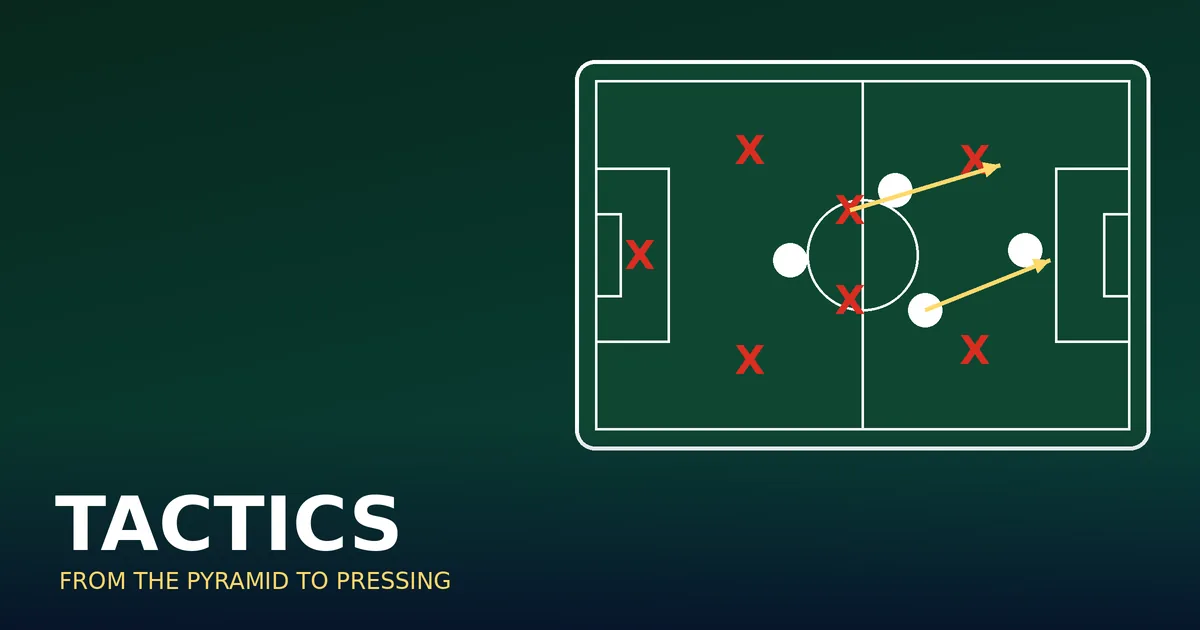
Every team has a shape and an idea. Tactics are the way coaches organise players to attack, defend and control space. They look complicated on television, but the story of tactics is really a story of problems and solutions. Whenever a team found a way to win, other teams found a way to stop it.
This guide follows the main tactical ideas from the earliest days to today, explains the terms commentators use and gives you a simple method for understanding a match.
The 2-3-5 pyramid
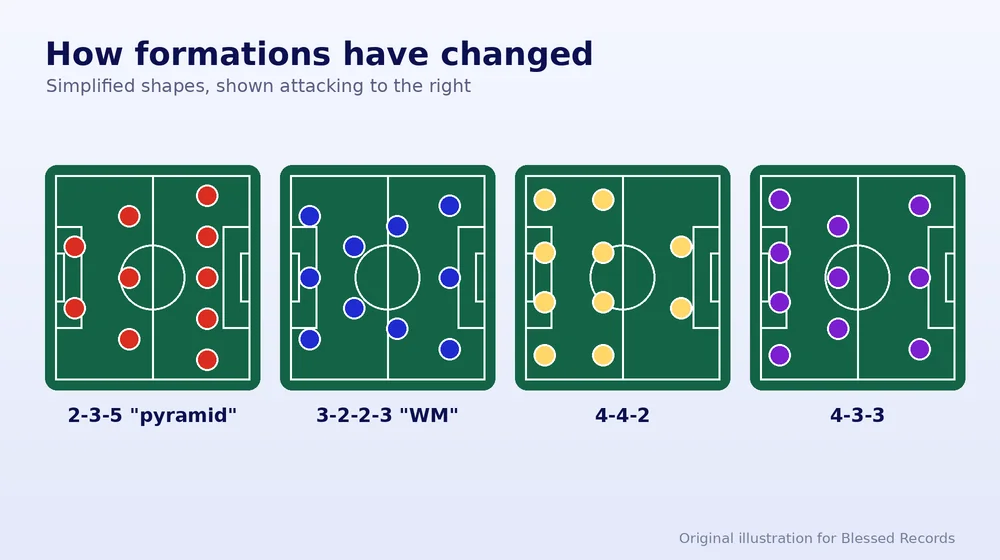
In the late 1800s, most teams played with two defenders, three midfielders and five forwards, a shape known as the pyramid or 2-3-5. Football was about attacking, and matches often ended with many goals. Scotland’s passing game and England’s dribbling both fitted this shape, which dominated for about fifty years.
The WM and the offside change
In 1925, the offside law changed, and goals suddenly increased. Herbert Chapman, the manager of Arsenal, responded by moving a midfielder back to become a third defender. The shape was called the WM, because the players’ positions resembled those letters, and Arsenal won several league titles in the 1930s with it. Teams across the world copied the idea.
Hungary’s golden team
In November 1953, Hungary beat England 6-3 at Wembley, the first time England had lost at home to a team from outside the British Isles. Hungary’s centre-forward Nandor Hidegkuti played deeper than a normal striker, which confused English defenders who did not know whether to follow him. The “Magical Magyars” showed that flexible positions could beat rigid ones.
Brazil’s 4-2-4 and Italy’s catenaccio
- Brazil, 1958: Brazil won the World Cup with a 4-2-4 system, with four defenders, two midfielders and four attackers, including Pele and Garrincha. It combined organisation with individual freedom.
- Catenaccio, 1960s: The Italian word means “door-bolt”. Inter Milan, coached by Helenio Herrera, used a sweeper behind the defenders and counter-attacks, and won the European Cup in 1964 and 1965. It was less about beauty and more about discipline.
Total Football
In the early 1970s, Rinus Michels and Johan Cruyff made Ajax and the Netherlands famous with Total Football. Players moved between positions, so when a defender went forward, a midfielder or forward covered his place. Ajax won the European Cup three years in a row from 1971 to 1973, and the Netherlands reached the 1974 World Cup final. The idea was that every player could play anywhere, and the team always kept its shape.
Pressing and zonal marking
In the late 1980s, Arrigo Sacchi’s AC Milan changed defending again. They played as a compact group, pushed up the pitch together, pressed the opponent in teams of players and used zonal marking, which means defending areas of the pitch rather than following individual players. Milan won the European Cup in 1989 and 1990. Sacchi’s ideas influenced many coaches who followed.
The 4-4-2 era
By the 1990s, the 4-4-2 was the most popular system in many leagues, especially in England. Two banks of four players made the team compact, with two strikers up front. Sir Alex Ferguson’s Manchester United used wingers and attacking full-backs to win many titles with it.
Tiki-taka and possession football
Pep Guardiola’s Barcelona, from 2008 to 2012, and the Spain team that won Euro 2008, the 2010 World Cup and Euro 2012, played a style known as tiki-taka. Teams passed the ball in short, quick movements, kept possession for long periods and pressed immediately after losing the ball. Players such as Xavi, Iniesta and Busquets controlled matches by controlling the ball.
Gegenpressing and counter-attacking
After tiki-taka, coaches looked for ways to beat possession teams. Jurgen Klopp’s Borussia Dortmund and Liverpool popularised gegenpressing, which means “counter-pressing”. The idea is to press the opponent immediately after losing the ball, when they are least organised, and to attack quickly. Liverpool won the Champions League in 2019 and the Premier League in 2020 with this approach. Counter-attacking teams, such as Leicester City in their title-winning season of 2015 to 2016, also showed that a side with less possession could still win by being quick and organised.
Modern trends
- Back threes and wing-backs: Antonio Conte’s Chelsea won the Premier League in 2016 to 2017 with a 3-4-3 system, and many teams now use three centre-backs.
- Inverted full-backs: Full-backs who move into midfield when their team has the ball, a feature of some of Pep Guardiola’s teams.
- False nine: A centre-forward who drops deep to create space for others.
- Set-pieces: Teams now hire specialist coaches and use video analysis to score from corners and free kicks.
- Data: Coaches use detailed statistics to understand where and how to press.
Defensive shapes explained
- High line: The defenders stand far up the pitch, close to the halfway line, to squeeze space and support pressing. It is risky if a pass goes behind them.
- Low block: The team sits deep, close to its own goal, and tries to stay compact and break forward quickly.
- Offside trap: Defenders step up together just before a pass is played so that an attacker is caught offside.
- Zonal and man-to-man marking: In zonal marking, players guard areas. In man-to-man marking, they follow an opponent. Many teams mix the two, especially at set-pieces.
Tactical words you hear on television
- Build-up: How a team moves the ball out from its goalkeeper and defenders towards the opponent’s half.
- Transition: The moment possession changes, when a team must switch quickly from attack to defence or the other way round.
- Overlap: A full-back running past a winger on the outside to give an extra passing option.
- Half-space: The channel between the centre and the touchline, where many dangerous passes are played.
- Playmaker: The player who dictates the rhythm of the team and creates chances for others.
- Pressing trigger: A signal, such as a poor touch or a backwards pass, that tells the team to press together.
The thinkers behind the tactics
Tactics are the work of coaches, and some are remembered as inventors. Herbert Chapman, Rinus Michels, Helenio Herrera, Arrigo Sacchi, Johan Cruyff, Pep Guardiola and Jurgen Klopp all changed how teams play. Many learned from one another. Guardiola was shaped by Cruyff, Klopp by the work of Sacchi and Ralf Rangnick, and Cruyff by Michels. The story of tactics is also a story of ideas passed from one generation of coaches to the next.
How to watch a match like an analyst
- Look at the shape when a team defends and when it attacks. They are usually different.
- Watch what happens after a team loses the ball. Do they press or fall back?
- Notice where the full-backs and midfielders stand during build-up.
- Check where the space is. Good teams move the ball to where the opponent is weakest.
- Watch the substitutions, because changes in shape often decide close games.
Key takeaways
- Tactics change in response to rule changes and rival teams.
- The 1925 offside law led to the WM formation.
- Total Football, tiki-taka and gegenpressing each changed how teams attack and defend.
- Formations are only starting points. Movement and ideas matter more.
- Watching shape, pressing and space helps you understand any match.
Frequently asked questions
What is the best formation in football?
There is no best formation. A formation is only a starting shape, and its success depends on the players, the coach’s ideas and the opponent.
What is pressing?
Pressing means winning the ball back high up the pitch by closing down opponents quickly and as a team.
What is a false nine?
A centre-forward who plays deeper than a normal striker, pulling defenders out of position and creating room for teammates.
What does catenaccio mean?
It is Italian for “door-bolt”. It describes a very defensive, disciplined system built around a sweeper and fast counter-attacks.
Keep reading
About this article. Written by the Blessed Records Exclusive Entertainment editorial team from published football history and official records. The images are original illustrations made for this site. We update our guides when facts change. If you spot a mistake, please contact us and we will check it.