

Ask ten people who invented football and you will get ten answers. The honest answer is that nobody did. People have been kicking balls for thousands of years, and the sport we watch today was shaped by schoolboys, factory workers, sailors, teachers and committees across many countries.
This guide follows that story from the earliest ball games to the first written rules of 1863, then on to the spread of the game around the world and the rise of the global sport we know today. It is written for fans who want the full picture in one place, without the jargon.
Ball games before football
People kicked balls long before anyone wrote a rulebook. In China, a game called cuju, in which players kicked a leather ball into a net stretched between poles, was played at least two thousand years ago. FIFA has described it as one of the earliest known forms of a kicking game. Other civilisations had their own versions, including harpastum in ancient Rome, episkyros in ancient Greece, and the ritual ball games of Mesoamerica.
None of these was football as we know it, and none of them led in a straight line to the modern sport. What they show is that kicking and chasing a ball is something humans keep inventing, in every region and in every century.
Medieval “mob football” in Britain
From the Middle Ages, villages and towns across Britain played huge, rough ball games, often on feast days such as Shrove Tuesday. Rules were local and loose. One team might be a whole parish, the goals could be a mile or more apart, and the number of players was unlimited. Injuries were common and property was often damaged.
Authorities did not like it. Several English kings issued proclamations against football, and Edward II is recorded as banning it in London in 1314 because of the disorder it caused. The ban did not end the game. Some of these old contests survive today, and the Royal Shrovetide Football match in Ashbourne, Derbyshire, is still played every year.
The schools write the first rules
In the early 1800s, English public schools such as Eton, Harrow, Winchester, Charterhouse and Rugby turned football into an organised school activity. The problem was that every school played by its own rules. Eton’s pitch was narrow, so its game suited dribbling. At Rugby, carrying the ball became part of the game. When old boys went on to university, they struggled to agree on how to play together.
In 1848, students at Cambridge University met to write a common set of rules. The Cambridge Rules of 1848 are considered a major influence on what came next. Meanwhile, in Sheffield, a group of men formed Sheffield Football Club in 1857, and it is widely recognised as the oldest football club in the world. Sheffield’s own rules also shaped the game and introduced ideas such as the corner kick and the crossbar.
26 October 1863: the Football Association is born
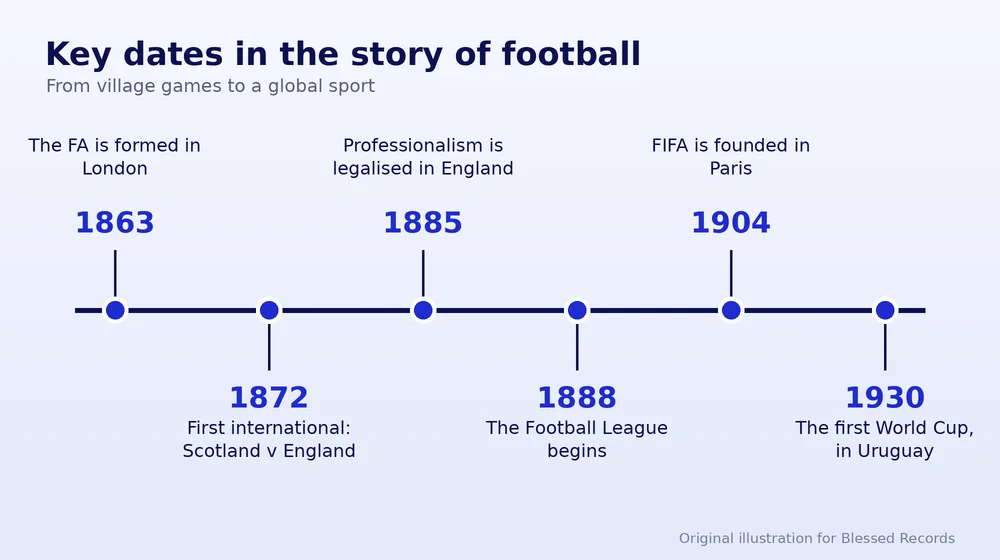
The most important date in the story is 26 October 1863. Representatives of London-area clubs and schools met at the Freemasons’ Tavern in Great Queen Street, London, and formed the Football Association, known as the FA. Their goal was simple: agree one set of rules so that teams could play each other fairly.
The big argument was about two things: carrying the ball and “hacking”, which meant deliberately kicking an opponent’s shins. Clubs that wanted to keep carrying and hacking walked away. Those who stayed adopted a set of 13 laws in December 1863 that banned both. The split created two separate sports. One became association football, and the other became rugby football.
The word “soccer” is a nickname that grew out of “association”. It was in common use in England in the late 1800s, long before it became the usual word in North America.
From pastime to profession
Once the rules existed, competition followed quickly. The first FA Cup was played in 1871 to 1872, and Wanderers won it. On 30 November 1872, Scotland and England played the first official international match in Glasgow, and it ended 0-0. Scottish players became known for a passing style, while the early English game relied more on dribbling.
Crowds grew fast, and factory towns in the north and Midlands of England wanted strong teams. Clubs began paying players, often in secret. In 1885 the FA legalised professionalism. Three years later, in 1888, the Football League was formed with 12 clubs, an idea driven by a Scottish-born businessman named William McGregor. Preston North End won the first league title without losing a single match, and they also won the FA Cup that year. That team is remembered as “the Invincibles”.
How football spread around the world
Football travelled with people. British sailors, merchants, railway engineers, soldiers, teachers and missionaries carried the game to every continent, and local people made it their own.
- South America: Charles Miller, who studied in England, brought footballs and a copy of the rules to São Paulo, Brazil, in 1894. Football in Argentina and Uruguay grew from British communities and schools in the same era.
- Europe: Clubs formed in Spain, Italy, Germany, the Netherlands and elsewhere in the late 1800s, many of them started by British expatriates or by local people who had seen the game abroad.
- Africa: Football spread through colonial schools, military units, missionary stations and port cities. Africans quickly built their own clubs and competitions, and today it is the most popular sport on the continent.
By the start of the 1900s, the game had grown too big to be run by one country. FIFA, the international federation, was founded in Paris on 21 May 1904 by the football associations of Belgium, Denmark, France, the Netherlands, Spain, Sweden and Switzerland. England joined the following year. Football also became an Olympic sport, and Uruguay won the Olympic tournaments of 1924 and 1928, which helped convince FIFA to start a World Cup.
The modern era
The first World Cup took place in Uruguay in 1930, and the tournament has been held every four years since, apart from the Second World War years. Television turned football into a worldwide spectacle during the 1960s and 1970s, and the 1990s brought bigger changes. The Premier League began in England in 1992, the UEFA Champions League was relaunched in the same year, and the Bosman ruling of 1995 changed how players move between clubs.
In recent decades, women’s football has grown quickly, technology such as goal-line systems and video review has entered the game, and the World Cup expanded to 48 teams in 2026. Spain won that tournament by beating Argentina 1-0 after extra time in the final in New Jersey.
Why the history still matters
Many of football’s rules and traditions come from decisions made more than 150 years ago, and knowing that helps explain the modern game. The offside rule exists because early players feared “goal-hanging”. Clubs have names like “Wanderers” and “Athletic” because they began as local social clubs. Rivalries, stadium names and even club colours often trace back to a school, a factory or a church.
Football also shows how quickly a simple idea can travel. A small set of rules written by a few men in a London tavern became a language that billions of people now share.
Key takeaways
- Nobody invented football. Many societies had ball games, but the modern rules were first agreed in England.
- The Football Association was formed on 26 October 1863, and its laws separated football from rugby.
- Sheffield FC (1857) is widely recognised as the oldest football club in the world.
- The first international match was Scotland 0-0 England in 1872, and the Football League began in 1888.
- FIFA was founded in 1904 and the first World Cup was played in 1930.
Frequently asked questions
Who invented football?
No single person did. Ball games existed in many ancient cultures, and the modern version was shaped by English schools and clubs. The FA’s laws of 1863 are usually treated as the start of the association football we play today.
What is the oldest football club in the world?
Sheffield Football Club, founded in 1857, is widely recognised as the oldest football club. Notts County, founded in 1862, is often described as the oldest professional football club in the world.
Why do Americans call it soccer?
The word comes from a nickname for “association” football, and it was in common use in England in the late 1800s. England later used “football” almost entirely, while the United States and some other countries kept “soccer”.
When did football reach Africa and Nigeria?
The game reached Africa through colonial schools, the military, missionaries and port cities, mostly in the late 1800s and early 1900s. Africans quickly formed their own clubs and leagues, and football is now the most popular sport on the continent.
Keep reading

About this article. Written by the Blessed Records Exclusive Entertainment editorial team from published football history and official records. The images are original illustrations made for this site. We update our guides when facts change. If you spot a mistake, please contact us and we will check it.