

The FIFA World Cup is the biggest event in football and one of the largest sporting events on earth. It is played every four years, and billions of people watch some part of it. The story of how a small tournament in Uruguay became a global festival is a story of ambition, war, colonial history, television and money.
This guide covers the whole story, from the first match in 1930 to the 2026 tournament in Canada, Mexico and the United States, with the champions, the key rule changes and the African milestones along the way.
Why FIFA created a World Cup
FIFA was founded in 1904, but its early years were quiet. Football was an Olympic sport, and Uruguay won the Olympic tournaments in 1924 and 1928. FIFA’s French president, Jules Rimet, believed football needed its own championship, open to professionals, and in 1928 FIFA members voted to create one. Uruguay was chosen as host because it was the reigning Olympic champion and was celebrating 100 years since its first constitution.
The first World Cup, 1930
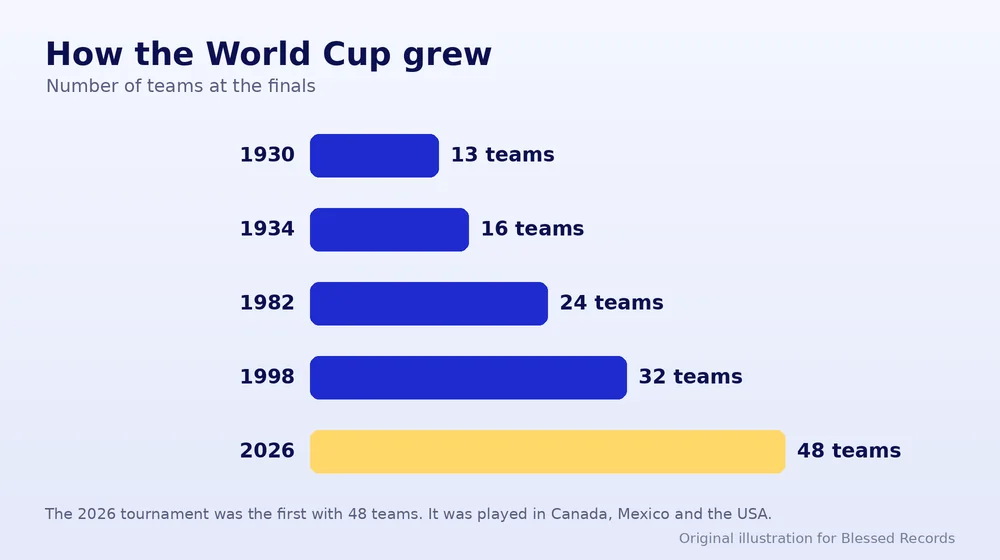
The first tournament took place in Montevideo in July 1930 with only 13 teams. Seven came from South America, four from Europe and two from North America. Many European teams stayed home because the sea voyage took weeks. Uruguay beat Argentina 4-2 in the final at the Estadio Centenario and became the first world champions.
The early years and the war
- 1934, Italy: The hosts won, in a tournament shaped by politics. Egypt became the first African team at a World Cup.
- 1938, France: Italy won again.
- 1942 and 1946: No tournaments were played because of the Second World War.
- 1950, Brazil: Uruguay beat Brazil 2-1 in front of a huge crowd at the Maracanã in a decisive match, a result known in Brazil as the Maracanazo.
- 1954, Switzerland: West Germany beat the great Hungarian side 3-2 in the final in what is called the Miracle of Bern.
Brazil, Pelé and the colour television age
In 1958, a 17-year-old named Pelé scored in the knockout stages and helped Brazil win their first World Cup in Sweden. Brazil won again in 1962 and in 1970 in Mexico, a tournament seen by many as the first great colour television World Cup. After the third title, Brazil kept the original Jules Rimet Trophy. A new FIFA World Cup Trophy, made largely of 18-carat gold and designed by the Italian sculptor Silvio Gazzaniga, was introduced in 1974 and is the one lifted today. Winners receive a replica to keep.
England won the tournament once, at home in 1966, beating West Germany 4-2 after extra time in the final at Wembley.
The 1970s to the 1990s
West Germany won in 1974 and 1990, Argentina in 1978 and 1986, and Italy in 1982. Diego Maradona dominated the 1986 tournament in Mexico, scoring a famous goal with his hand against England and, minutes later, a solo goal that is still voted among the best ever. In 1982 the tournament grew from 16 to 24 teams. The 1994 World Cup in the United States produced record crowds and was won by Brazil on penalties.
A global tournament, 1998 to 2022
In 1998, the tournament grew to 32 teams, and host nation France won its first title. Since then:
- 2002: The first World Cup in Asia, co-hosted by South Korea and Japan, won by Brazil.
- 2006: Italy beat France on penalties in Germany.
- 2010: The first World Cup in Africa, in South Africa, won by Spain, who lifted the trophy for the first time.
- 2014: Germany won in Brazil after beating the hosts 7-1 in the semi-final.
- 2018: France won in Russia.
- 2022: The first World Cup in the Middle East, held in Qatar in November and December. Argentina beat France on penalties after a 3-3 draw, and Lionel Messi finally won the trophy.
The 2026 World Cup
The 2026 tournament, hosted by Canada, Mexico and the United States, was the first with 48 teams and 104 matches, played in 16 host cities between 11 June and 19 July 2026. Mexico became the first country to host the men’s World Cup three times. The teams played in 12 groups of four, and the top two in each group and the eight best third-placed teams moved to a new round of 32.
Spain beat Argentina 1-0 after extra time in the final at MetLife Stadium in New Jersey. Ferran Torres scored the only goal in the 106th minute, and the result gave Spain their second World Cup title, 16 years after their first.
Who has won the World Cup?
Eight countries have won the men’s World Cup.
- Brazil: five titles (1958, 1962, 1970, 1994, 2002)
- Germany: four (1954, 1974, 1990, 2014), including as West Germany
- Italy: four (1934, 1938, 1982, 2006)
- Argentina: three (1978, 1986, 2022)
- France: two (1998, 2018)
- Uruguay: two (1930, 1950)
- Spain: two (2010, 2026)
- England: one (1966)
How a team qualifies
Qualifying is run by FIFA’s six regional confederations: UEFA in Europe, CAF in Africa, AFC in Asia, CONMEBOL in South America, CONCACAF in North and Central America and the Caribbean, and OFC in Oceania. For 2026, the places were shared like this: 16 for Europe, 9 for Africa, 8 for Asia, 6 for South America, 6 for CONCACAF (including the three hosts), 1 for Oceania, and two more places decided in an intercontinental play-off.
Qualifying takes about two to three years and is often as dramatic as the tournament itself. Large nations can fail. Italy missed the 2018 and 2022 tournaments, and Nigeria missed both 2022 and 2026 after losing a play-off.
Moments the world remembers
- 1950: The Maracanazo, when Uruguay silenced the biggest crowd football had seen.
- 1970: Brazil’s team, with Pelé, Jairzinho and Carlos Alberto, is often called the greatest ever.
- 1986: Maradona’s two goals against England.
- 1994: Nigeria’s Super Eagles reach the knockout stage at their first World Cup.
- 2002: Senegal beat the reigning champions, France, in the opening match.
- 2014: Germany’s 7-1 win over Brazil in Belo Horizonte.
- 2022: Argentina and France play one of the most dramatic finals ever, and Messi lifts the trophy.
- 2026: Spain win after extra time against Argentina in the first 48-team World Cup.
Africa at the World Cup
Egypt were the first African team to play in 1934. Cameroon reached the quarter-finals in 1990 and Senegal did so in 2002, while Ghana narrowly missed a semi-final in 2010 after a dramatic penalty shoot-out against Uruguay. In 2022, Morocco became the first African team to reach the semi-finals. Africa has nine direct places at the 48-team tournament, plus a chance to win an extra place through a play-off. Nigeria has played at six World Cups (1994, 1998, 2002, 2010, 2014 and 2018) but missed the 2022 and 2026 tournaments.
What happens next?
The next men’s World Cup is in 2030, hosted by Spain, Portugal and Morocco, with three opening matches in Uruguay, Argentina and Paraguay to mark 100 years since the first tournament. Saudi Arabia will host in 2034. Alongside the men’s competition, the FIFA Women’s World Cup has been played since 1991 and has become a major event in its own right.
Key takeaways
- The first World Cup was played in Uruguay in 1930 with 13 teams.
- Brazil has won five titles, more than any other nation.
- The tournament grew to 32 teams in 1998 and to 48 teams in 2026.
- Spain won the 2026 World Cup, beating Argentina 1-0 after extra time.
- Morocco’s semi-final in 2022 is the best result by an African team.
Frequently asked questions
Which country has won the most World Cups?
Brazil, with five titles: 1958, 1962, 1970, 1994 and 2002.
Who won the 2026 World Cup?
Spain beat Argentina 1-0 after extra time in the final on 19 July 2026. Ferran Torres scored in the 106th minute.
Why does the World Cup have 48 teams now?
FIFA expanded the tournament to give more countries a chance to qualify and to include more of the world’s football associations. It means 104 matches are played instead of 64.
How many times has Nigeria played at the World Cup?
Six times: 1994, 1998, 2002, 2010, 2014 and 2018. Nigeria did not qualify for the 2022 or 2026 tournaments.
Keep reading
About this article. Written by the Blessed Records Exclusive Entertainment editorial team from published football history and official records. The images are original illustrations made for this site. We update our guides when facts change. If you spot a mistake, please contact us and we will check it.