

Few national teams can match the passion that surrounds the Super Eagles. Nigerian football has produced Olympic gold medallists, world champions at youth level, African champions and some of the continent’s most skilful players. It has also given its fans more than a few heartbreaks.
This guide tells the story of Nigeria’s national team, from the early years to the latest campaigns, and explains why football means so much to Nigerians.
The early years
Football grew in Nigeria through schools, the military and clubs in Lagos and other cities in the early 1900s. The Nigeria Football Federation, which began in the 1940s as the Nigeria Football Association, now organises the national teams and leagues. After independence in 1960, the national team, then nicknamed the Green Eagles, began to compete seriously in Africa. Nigeria reached the semi-finals of the Africa Cup of Nations in the 1970s and finished third twice, which prepared the way for the first title.
The first title at home, 1980
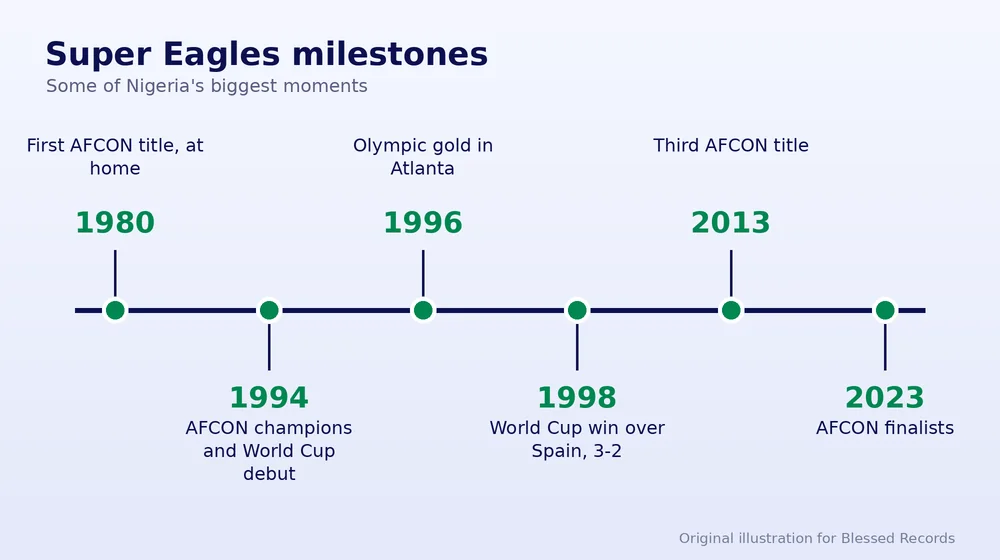
Nigeria hosted the 1980 Africa Cup of Nations and won it. The Green Eagles beat Algeria 3-0 in the final in Lagos, and players such as Segun Odegbami and Christian Chukwu became national heroes. The title proved that Nigeria could win on the continent’s biggest stage, and it inspired a generation.
The golden generation, 1994 to 1998
The early 1990s produced one of the most talented squads Africa has seen. Under Dutch coach Clemens Westerhof, the Super Eagles won the 1994 Africa Cup of Nations in Tunisia, beating Zambia 2-1 in the final, with two goals from Emmanuel Amuneke. Captain Stephen Keshi, who would later win the trophy again as a coach, led the side.
Nigeria then qualified for the World Cup for the first time, in the United States in 1994. Rashidi Yekini scored Nigeria’s first World Cup goal in a 3-0 win over Bulgaria, and the team won its group, only losing to Italy in the round of 16 after a late goal. In 1998 in France, Nigeria beat Spain 3-2 in one of the best matches of the tournament, but lost to Denmark in the round of 16.
Olympic gold in Atlanta, 1996
In 1996, a young Nigerian team coached by Jo Bonfrere won gold at the Olympic Games in Atlanta. In the semi-final, Nigeria beat Brazil 4-3 after extra time with a golden goal from Kanu Nwankwo. In the final they beat Argentina 3-2, with Amuneke scoring the winner late in the match. Nigeria became the first African nation to win the men’s Olympic football gold medal.
Nigeria at the World Cup
Nigeria has qualified for six World Cups: 1994, 1998, 2002, 2010, 2014 and 2018. The best result was reaching the round of 16 in 1994, 1998 and 2014. In 2018, Nigeria were eliminated in the group stage after a 2-1 defeat to Argentina in their final match.
Then came two painful absences. Nigeria missed the 2022 World Cup after a play-off defeat to Ghana, and missed the 2026 tournament after losing to DR Congo on penalties in the African play-off final in Rabat on 16 November 2025. It was the first time since their debut in 1994 that the Super Eagles had missed two World Cups in a row.
Africa Cup of Nations since 2013
- 2013: Under coach Stephen Keshi, Nigeria won their third title in South Africa, beating Burkina Faso 1-0 in the final.
- 2019: Nigeria finished third.
- 2023: Nigeria reached the final in Ivory Coast and lost 2-1 to the hosts.
- 2025: Nigeria finished third in Morocco, beating Egypt on penalties in the third-place match after a semi-final penalty defeat to the hosts.
Super Eagles legends
- Rashidi Yekini: Nigeria’s greatest goalscorer for many years and the man who scored the first World Cup goal for the country.
- Nwankwo Kanu: Olympic gold medallist and a European champion with Ajax, famous for his skill and long career in England.
- Jay-Jay Okocha: A creative midfielder admired around the world for his dribbling and flair.
- Joseph Yobo, John Obi Mikel and Vincent Enyeama: The defender, midfielder and goalkeeper who led later generations, including the 2013 champions.
- Victor Osimhen and Ademola Lookman: African Footballer of the Year winners in 2023 and 2024.
Youth teams and the Super Falcons
Nigeria has had remarkable success at youth level. The Golden Eaglets have won the FIFA Under-17 World Cup five times (1985, 1993, 2007, 2013 and 2015), more than any other country. The women’s national team, the Super Falcons, have won the Women’s Africa Cup of Nations more than any other team and have appeared at every Women’s World Cup since the first, in 1991.
Why the Super Eagles matter
For Nigerians, the national team is much more than a sports team. Matches can bring together fans from many ethnic groups, religions and regions. Streets go quiet before kick-off, viewing centres fill up and a single goal can start a national celebration. The team’s green and white kits have also become a fashion statement around the world, especially after the widely praised designs of 1994 and 2018.
The league and the clubs behind the national team
The national team depends on a pipeline that starts in local clubs. Nigeria’s top division, the Nigeria Premier Football League, is the main domestic stage, and clubs such as Enyimba of Aba have won the CAF Champions League. Many Nigerian stars began in these leagues or in state-run and private academies before moving to Europe, and the same pathway continues today. A strong league keeps more talent at home for longer, helps coaches find the next generation and brings football closer to local communities.
The national team also relies on age-grade squads. The Golden Eaglets (Under-17), the Flying Eagles (Under-20) and the Under-23 team give young players their first taste of international football, and several Super Eagles first made their names at youth World Cups.
The fans and the culture
Nigerian fans are famous for their noise, colour and humour. Supporters travel in large numbers to away matches in Africa, sing and drum through entire games, and turn even a qualifier into a street party. The “Super Eagles” nickname became popular in the late 1980s and early 1990s and is now used by fans across the world. Social media has also helped create a global community of Nigerian football supporters, who share memories of the 1994 team as eagerly as they discuss the current squad.
What does Nigerian football need?
Fans and experts often point to the same priorities: well-run domestic leagues, modern stadiums and training grounds, reliable payment of players and staff, stable leadership, and strong youth academies. Nigeria will always produce talent. The challenge is to build a system that develops that talent at home and supports it all the way to the national team.
Key takeaways
- Nigeria has won the Africa Cup of Nations three times: 1980, 1994 and 2013.
- The Super Eagles won the 1996 Olympic gold medal, the first for any African team.
- Nigeria has played at six World Cups but missed 2022 and 2026.
- The Golden Eaglets have won the Under-17 World Cup five times.
- The Super Falcons have won more Women’s Africa Cup of Nations titles than any other team.
Frequently asked questions
How many times have the Super Eagles won the Africa Cup of Nations?
Three times: 1980, 1994 and 2013.
Why did Nigeria miss the 2026 World Cup?
Nigeria lost the African play-off final to DR Congo on penalties on 16 November 2025, after a 1-1 draw. DR Congo went on to the intercontinental play-off stage.
Who scored Nigeria’s first World Cup goal?
Rashidi Yekini, against Bulgaria at the 1994 World Cup.
Who was the Nigerian player of the year in Africa in 2023 and 2024?
Victor Osimhen won the CAF African Footballer of the Year award in 2023, and Ademola Lookman won it in 2024.
Keep reading


About this article. Written by the Blessed Records Exclusive Entertainment editorial team from published football history and official records. The images are original illustrations made for this site. We update our guides when facts change. If you spot a mistake, please contact us and we will check it.