

Football is the most popular sport in Africa. It fills stadiums, empties streets during big matches and has produced some of the most admired players in the world. The story of African football is also a story of independence, pride and talent that often had to leave home to be seen.
This guide explains how the game spread across the continent, how the Confederation of African Football (CAF) and the Africa Cup of Nations (AFCON) were created, who the great champions are, and what challenges and opportunities African football faces today.
How football arrived in Africa
Football reached Africa in the late 1800s and early 1900s, carried by colonial administrators, soldiers, teachers, missionaries and sailors, and it spread quickly through schools, port cities and army camps. Africans did not simply copy the game. They formed their own clubs, created local competitions and developed styles that suited their communities. In many countries, clubs became a symbol of national pride and, during the independence era, a way to express identity.
CAF is founded in 1957
As independence movements grew, African football leaders wanted a body of their own. CAF was founded in February 1957 in Khartoum, Sudan. The founding members were Egypt, Ethiopia, Sudan and South Africa. The same month, the first Africa Cup of Nations was played in Khartoum with only three teams: Egypt, Sudan and Ethiopia. South Africa had been entered but was excluded because the country’s apartheid policies meant its team could only include white players. Egypt won the first title.
The Africa Cup of Nations through the decades
- 1950s and 1960s: Egypt won the first two tournaments, in 1957 and 1959. Ethiopia won in 1962, then Ghana became the first great power and won in 1963 and 1965. Congo-Kinshasa won in 1968.
- 1970s: Sudan, Congo-Brazzaville, Zaire, Morocco and Ghana all won. Zaire’s 1974 win led them to become the first sub-Saharan African team at a World Cup.
- 1980s: Nigeria won their first title in 1980 at home. Cameroon won in 1984 and 1988, and Egypt in 1986.
- 1990s: Algeria (1990), Ivory Coast (1992), Nigeria (1994), South Africa (1996) and Egypt (1998) won. South Africa’s 1996 title came in their first tournament after returning to international football following the end of apartheid.
- 2000s: Cameroon won in 2000 and 2002, Tunisia in 2004, and Egypt in 2006 and 2008.
- 2010s and 2020s: Egypt won again in 2010, taking their total to seven. After that came Zambia (2012), Nigeria (2013), Ivory Coast (2015), Cameroon (2017), Algeria (2019), Senegal (2021) and Ivory Coast again (2023).
The tournament was expanded to 24 teams in 2019, and it has moved to a January and February window in recent editions so that more of Africa’s top players can take part, although that has caused arguments with European clubs.
Who has won the most?
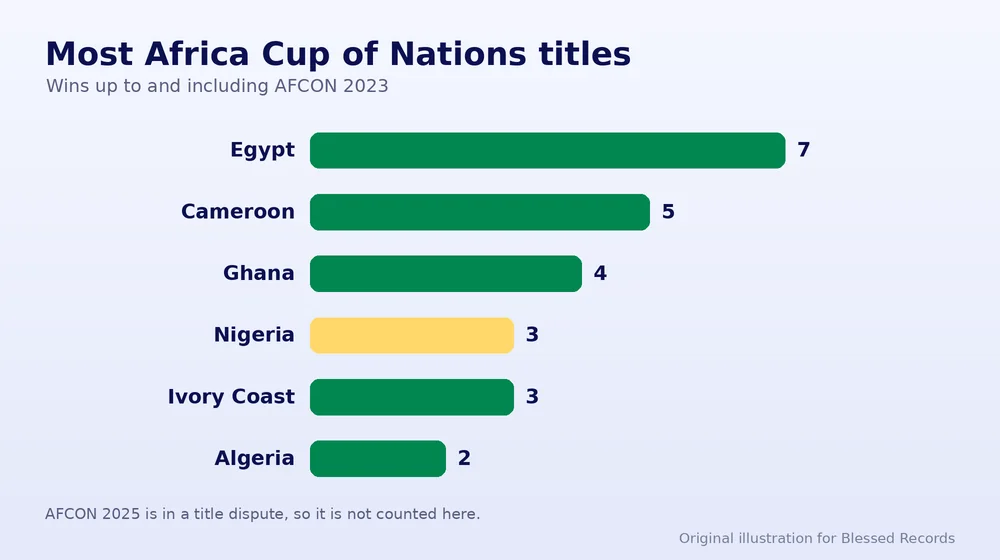
Up to and including the 2023 tournament, Egypt had won seven titles, Cameroon five, Ghana four, and Nigeria and Ivory Coast three each. Algeria have two, and Senegal, South Africa, Zambia, Tunisia, Morocco and several other nations have won once or more. The wide spread of winners shows how competitive the continent has become.
Africa on the world stage
- 1934: Egypt became the first African team to play at a World Cup.
- 1974: Zaire became the first sub-Saharan African team at the World Cup.
- 1990: Cameroon, led by veteran striker Roger Milla, became the first African team to reach a World Cup quarter-final.
- 2002: Senegal beat France in the opening match and reached the quarter-finals.
- 2010: South Africa hosted the first World Cup on African soil.
- 2022: Morocco became the first African team to reach a World Cup semi-final.
At the 2026 World Cup, Africa had nine direct places, and the qualifiers were Algeria, Cape Verde, Ivory Coast, Egypt, Ghana, Morocco, Senegal, South Africa and Tunisia.
AFCON 2025: a title in dispute
The 2025 tournament in Morocco was played from December 2025 to January 2026. Nigeria finished third, beating Egypt on penalties in the third-place match after losing to Morocco on penalties in the semi-final. The final in Rabat was played on 18 January 2026, and Senegal won it 1-0, but only after a chaotic night in which several Senegal players briefly walked off the pitch to protest a penalty awarded to Morocco.
CAF’s Appeals Board later ruled that Senegal had forfeited the match, recorded the result as a 3-0 win for Morocco, and named Morocco the champions. Senegal rejected the decision and appealed to the Court of Arbitration for Sport. At the time this article was published on 31 October 2026, that court had said it would issue its final ruling at the end of November 2026. We will update this section once the decision is announced.
African stars and clubs
Football lovers across the world know the names of George Weah, who became the first African winner of the Ballon d’Or in 1995, and of Roger Milla, Abedi Pelé, Samuel Eto’o, Didier Drogba, Mohamed Salah, Sadio Mané, Riyad Mahrez and Achraf Hakimi. Nigeria has produced a long list as well, which we cover in our Super Eagles guide.
Africa’s club football has its own giants. Egypt’s Al Ahly are the most successful team in the history of the CAF Champions League, and TP Mazembe of the Democratic Republic of Congo, Zamalek, Enyimba, Esperance and Wydad Casablanca have all won the continent’s top trophy.
Club football and the road to Europe
Africa’s club competitions are the other half of the story. The CAF Champions League, launched in its modern form in the 1990s, gives clubs a chance to win continental glory and a place at the FIFA Club World Cup. Egypt and North Africa have often dominated, but clubs from West and Central Africa have broken through. Nigeria’s Enyimba won the competition in 2003 and 2004, and TP Mazembe, from the Democratic Republic of Congo, won in 2009, 2010 and 2015.
Meanwhile, the best young African players often leave early. A teenager from Lagos, Accra, Dakar or Abidjan may sign for a club in Belgium, Portugal, France or England before turning 20. That is why many African national teams are filled with players who learned their football in two different worlds. It also explains why the January and February timing of the Africa Cup of Nations is a constant discussion with European clubs.
The challenges and the opportunities
African football has real challenges. Many clubs struggle with funding, pitches and stadiums, and players are sometimes paid late. Governance problems have disrupted several national federations. The best young players often move to Europe at an early age, which strengthens foreign leagues while the domestic game is left with less talent and less income.
The opportunities are just as big. Africa has the youngest population in the world, and new academies, better coaching and wider television coverage are helping. The women’s game is growing, led by the Women’s Africa Cup of Nations, which started in 1991. If broadcast rights, stadiums and league organisation improve, African clubs can keep more of their talent and compete more strongly with the rest of the world.
Key takeaways
- CAF was founded in 1957, and the first Africa Cup of Nations was played the same year.
- Egypt have the most AFCON titles, with seven up to 2023.
- Morocco’s 2022 semi-final is the best African World Cup result so far.
- The 2025 AFCON title is in a legal dispute between Senegal and Morocco, and a final ruling is expected in November 2026.
- Better funding and organisation could help Africa keep more of its talent.
Frequently asked questions
When was the first Africa Cup of Nations?
February 1957, in Khartoum, Sudan. Three teams played, and Egypt won.
Which African country has won the most Africa Cup of Nations?
Egypt, with seven titles up to 2023. Cameroon have five, Ghana four, and Nigeria and Ivory Coast three each.
Who won AFCON 2025?
Senegal won the final on the pitch, 1-0 against Morocco. CAF’s Appeals Board later recorded Morocco as champions, and Senegal appealed to the Court of Arbitration for Sport, which was expected to rule at the end of November 2026.
Who was the first African player to win the Ballon d’Or?
George Weah of Liberia, in 1995.
Keep reading
About this article. Written by the Blessed Records Exclusive Entertainment editorial team from published football history and official records. The images are original illustrations made for this site. We update our guides when facts change. If you spot a mistake, please contact us and we will check it.