

The English Premier League is the most-watched football league in the world. Its matches are shown in hundreds of countries, its clubs have fans in every continent, and its transfer deals dominate the news. Yet it is barely thirty years old.
This guide explains how the league began, why the top clubs wanted a change, how television turned it into a global business, and what it means for the wider football industry.
Football before the Premier League
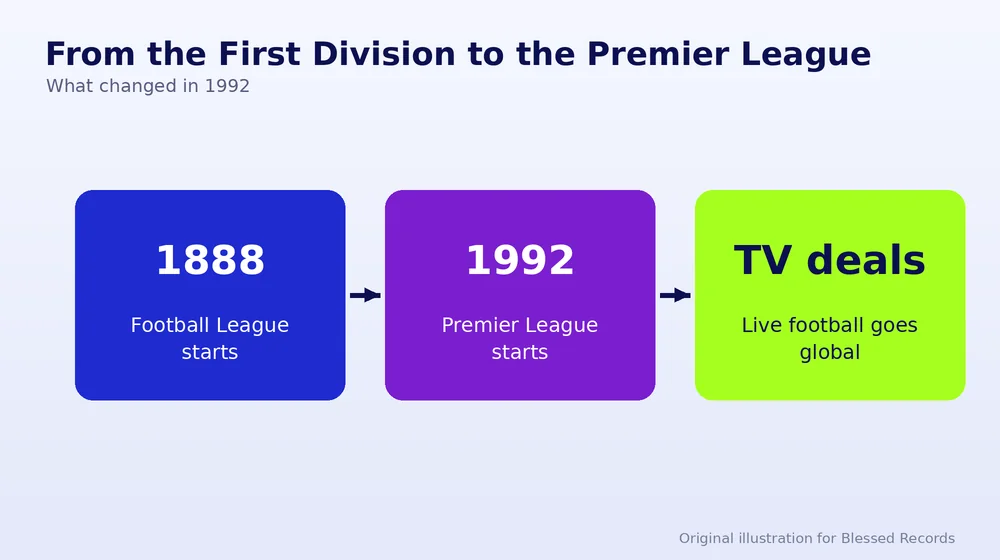
For more than a century, English football was run by the Football League, which was founded in 1888. By the 1980s, the game was struggling. Stadiums were old and often unsafe, hooliganism damaged the reputation of the sport and attendances had fallen. The 1985 Heysel disaster led to English clubs being banned from European competition for five years. In 1989, 97 Liverpool supporters died as a result of the crush at Hillsborough. The Taylor Report that followed in 1990 recommended that top-division grounds become all-seater, a change that improved safety and also changed the match-day experience.
Why the top clubs broke away
At the start of the 1990s, English football’s mood improved. England reached the semi-final of the 1990 World Cup, and new interest in the sport helped attract television money. The biggest clubs in the First Division believed they, not the whole league structure, were the main reason fans and broadcasters were interested. They wanted to negotiate their own television contracts and keep more of the income.
In 1991, the clubs signed an agreement to form a new competition. The FA Premier League was formally created on 20 February 1992, and the first season started in August 1992 with 22 clubs. The league later reduced to 20 clubs from the 1995 to 1996 season. Brian Deane of Sheffield United scored the first Premier League goal.
The television revolution
The key moment was the television deal. In 1992, the satellite broadcaster BSkyB won the right to show live Premier League matches, in a five-year agreement widely reported to be worth around £304 million. Football fans had to pay to watch many live games, the BBC kept a highlights programme, and the money began to rise with each new contract.
Over time, broadcasters competed aggressively for rights, and international rights were sold in a growing number of countries. Today, the league earns several billion pounds a season from broadcasting in the UK and overseas, and that money is shared among all 20 clubs, with the largest share paid equally.
Foreign stars and global fans
More money brought more talent. In the 1990s, players such as Eric Cantona, Dennis Bergkamp and Gianfranco Zola arrived, and managers such as Arsène Wenger introduced new training methods, nutrition and scouting from around the world. The league became more international every year, and by the 2000s, a large part of its players, coaches and owners came from outside England.
That helped attract fans overseas. In Nigeria and across Africa, Premier League match days fill bars, viewing centres and homes, and fans often support English clubs as passionately as local teams.
The story on the pitch
- Manchester United dominated the early years, winning 13 of the first 21 titles under Sir Alex Ferguson.
- Blackburn Rovers won the title in 1994 to 1995 with the help of a wealthy owner.
- Arsenal went through the entire 2003 to 2004 season unbeaten, earning the nickname “the Invincibles”.
- Leicester City won the title in 2015 to 2016 in one of the biggest surprises in sporting history.
- Manchester City won four titles in a row from 2020 to 2021 to 2023 to 2024, and Liverpool won in 2019 to 2020 and 2024 to 2025.
How the money is shared
The Premier League’s income is divided among all 20 clubs. A large part of the domestic television money is shared equally, and the rest is split according to where a club finishes in the table and how often its matches are shown live. Overseas television income is shared fairly evenly, and clubs also receive their own sponsorship and match-day income. Because the gaps between the top and bottom clubs are smaller than in many other leagues, the competition is often considered one of the most balanced in Europe, even if a handful of clubs remain richer than the others.
Clubs that are relegated to the second tier receive “parachute payments” for a few seasons to soften the drop in income. Some money also goes to the English Football League and to grassroots football, though how much should be shared is a regular subject of debate.
The Champions League connection
The Premier League did not rise alone. In 1992, the European Cup was reorganised and renamed the UEFA Champions League, creating a group stage with more matches and more television income for the best clubs in Europe. English clubs returned to European competition after their ban, and success in Europe, such as Manchester United’s Champions League win in 1999, helped sell the league to the world. The two competitions grew together and raised the value of football in the 1990s.
How the business changed
Football became a major industry. Clubs built bigger stadiums, signed global sponsors, sold shirts in new markets and played pre-season tours abroad. Foreign investors, from Russian and Middle Eastern owners to American investment groups, bought clubs. Transfer fees and salaries grew dramatically, and clubs hired large staffs of analysts, doctors and scouts.
The money also created concerns. Ticket prices rose, and many long-time supporters said they felt priced out. Clubs outside the top flight struggled to compete, and rules such as profit and sustainability limits and “parachute payments” for relegated clubs were introduced to control spending and protect the lower leagues. In April 2021, six English clubs announced plans to join a breakaway European Super League, but the idea collapsed within two days after protests from fans, players, managers and the government.
What it means for the football industry
The Premier League shows how powerful a clear brand, strong broadcasting deals and international appeal can be. Other leagues have copied parts of that model, and many national leagues now sell their rights in other countries. It also shows the risks of a game that depends heavily on television money and a small number of rich owners.
For young players, the league remains a dream destination. For fans, it provides world-class entertainment every week. For people in the football industry, from agents and coaches to analysts and marketing teams, it has created thousands of careers.
Key takeaways
- The Premier League was formed on 20 February 1992, and its first season began in August 1992.
- Television money, led by BSkyB, was the main reason the top clubs broke away.
- The league has grown into a global business with fans in nearly every country.
- Rising costs and ownership questions have led to new financial rules and a lot of debate.
- Other leagues have followed its model of selling rights worldwide.
Frequently asked questions
When did the Premier League start?
It was formed on 20 February 1992, and the first matches were played in August 1992.
Why did the top clubs leave the Football League?
They wanted to negotiate their own television deals and keep more of the money, because the top clubs were driving most of the interest in the sport.
How many clubs are in the Premier League?
Twenty. It began with 22 clubs and reduced to 20 from the 1995 to 1996 season.
Who won the first Premier League title?
Manchester United, in the 1992 to 1993 season.
Keep reading
About this article. Written by the Blessed Records Exclusive Entertainment editorial team from published football history and official records. The images are original illustrations made for this site. We update our guides when facts change. If you spot a mistake, please contact us and we will check it.