


Football looks like a business with endless money. Players are sold for huge fees, stadiums are rebuilt and shirts carry famous brand names. Yet many clubs, from small local teams to well-known names, run into financial trouble. To understand why, it helps to know how clubs earn money, where it goes and which rules try to keep them stable.
This guide explains the basics in plain language. It is useful for fans who follow transfer news, students of sports business, and anyone who wants to read a club’s accounts with confidence.
The three main sources of income
Most clubs earn money in three ways, and analysts usually place them in these groups.
Television and streaming companies pay leagues and competitions for the right to show matches. The league then shares that money with its clubs. For many top clubs, this is the largest income stream, and for smaller clubs in leagues with big television deals, it can be the difference between survival and trouble. Taking part in European competitions brings extra broadcasting money from UEFA.
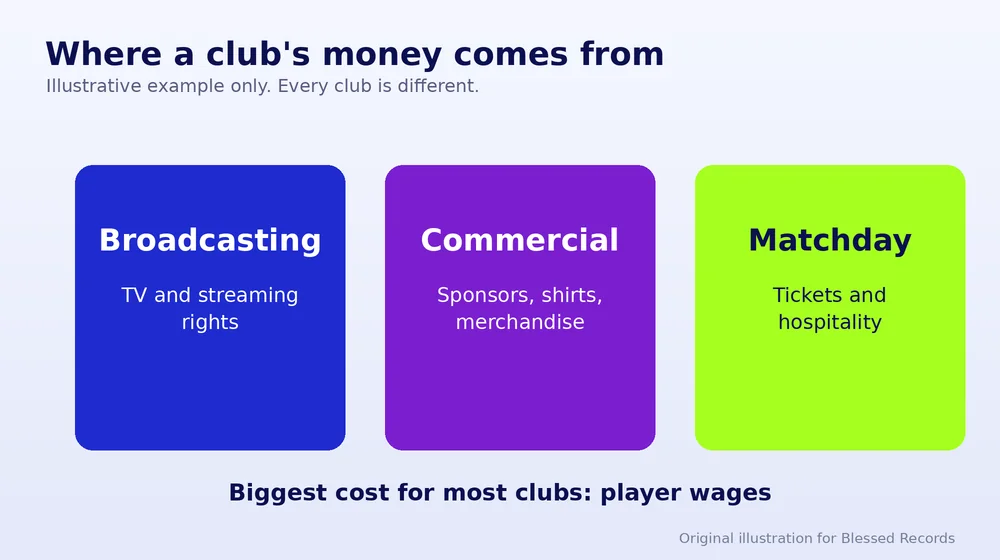
This is money from sponsors and partners. It includes the main shirt sponsor, the kit supplier, stadium naming rights, official partners, club shops, licensed products and online content. Clubs with global fan bases, such as Real Madrid, Manchester United or Barcelona, can earn very large amounts from commercial deals.
This comes from ticket sales, season tickets, hospitality boxes, food and drink and museum or stadium tours. For clubs with large stadiums that sell out every week, it is a major income stream. For many clubs outside Europe’s top leagues, it is the most important source of cash.
Selling players: a fourth source
Some clubs also make money by developing players and selling them for a profit. This is known as player trading. Clubs that are known for finding young talent, such as Ajax in the Netherlands, Benfica and Porto in Portugal, and many clubs in Belgium and France, often rely on this income. In Africa and South America, selling a promising player to a European club can pay for a club’s budget for several seasons.
There is a catch. A club that sells its best player may lose some of its performance, and transfer income can change greatly from one year to the next. Because of that, careful clubs treat transfer profit as a bonus rather than the basis of their budget.
Where the money goes
- Wages: The largest cost for almost every club. Players, coaches and staff are paid salaries and bonuses, and wages often take well over half of a club’s revenue.
- Transfer fees: Fees are not recorded as one big cost in the year they are paid. They are spread across the length of the player’s contract, a process called amortisation. A 100 million fee for a five-year contract is recorded as around 20 million a year.
- Stadium and operations: Maintenance, security, staff, travel, insurance and utilities.
- Academy and women’s teams: Investment in young players and in the women’s game, which usually runs at a loss but builds long-term value.
- Debt and interest: Clubs that borrow to build stadiums or buy players must pay the money back with interest.
A simple example
Here is an illustration with made-up numbers for a mid-sized club in a rich league.
- Broadcasting: 50 million
- Commercial: 30 million
- Matchday: 20 million
- Total revenue: 100 million
- Wages: 65 million (65 per cent of revenue)
- Amortisation of transfer fees: 20 million
- Other costs: 20 million
- Total costs: 105 million
This club loses 5 million before any transfer profit. If it sells a player for 15 million more than his accounting value, it moves into profit. If it does not, it must find money from its owner or from borrowing. This is how many clubs end up in a cycle where they depend on player sales or rich owners.
The financial rules
Without rules, wealthy owners could pour unlimited money into a club, which would be unfair to others. Football’s authorities have tried to limit that in several ways.
- UEFA Financial Fair Play, introduced in 2011: Clubs in European competitions were required to break even over a period of years. It was later replaced by new financial sustainability rules that include a limit on how much of a club’s revenue can be spent on wages, transfers and agent fees. The limit is 70 per cent.
- Premier League profit and sustainability rules: Clubs may only lose a fixed amount, set at 105 million pounds over a three-year period, with some costs, such as youth and women’s football, excluded. Clubs that break the rules can face points deductions, as Everton and Nottingham Forest learned in the 2023 to 2024 season.
- Parachute payments and salary controls: Many leagues give extra money to relegated clubs and set spending limits in the lower divisions.
These rules are updated regularly, so it is wise to check the current version of any league’s regulations.
Who owns clubs?
Clubs can be owned in very different ways. Many are owned by private individuals, companies or investment groups. Real Madrid and Barcelona are owned by their members, called socios, who vote for the president. In Germany, the “50+1” rule is designed to make sure that club members keep control of most Bundesliga clubs, although there are exceptions. In Nigeria and across Africa, many clubs are owned or supported by state governments, local companies or wealthy individuals, which creates both stability and risk, because funding can change when leaders change.
How to read a club’s accounts
You do not need to be an accountant. Start with four questions.
- How much is the club’s total revenue, and which stream is largest?
- What percentage of revenue goes on wages? Above 70 per cent is often seen as a warning sign.
- Does the club make a profit before selling players?
- How much debt does it have, and who is the lender?
Key takeaways
- Clubs earn money from broadcasting, commercial deals and match days, and many also sell players.
- Wages are the biggest cost for most clubs.
- Transfer fees are recorded over the length of a contract, not all at once.
- Financial rules try to stop clubs spending far more than they earn.
- Ownership model, whether private, member-owned or state-supported, affects how a club is run.
Frequently asked questions
What is the biggest source of income for a football club?
It depends on the club. For many top clubs in Europe it is broadcasting. For clubs with huge global fan bases it can be commercial income, and for smaller clubs outside the top leagues it is often match-day income and player sales.
What does amortisation mean in football?
It is an accounting method that spreads the cost of a transfer fee over the length of the player’s contract. A fee of 50 million for a five-year contract adds around 10 million a year to the club’s costs.
Why do clubs lose money even when revenue is rising?
Costs, especially wages and transfer fees, often rise as fast as income. Clubs may also take on debt to compete, so profit stays small or negative.
What is a parachute payment?
It is extra money paid to a relegated club for a few seasons to help it cope with the fall in income after leaving the top division.
Keep reading


About this article. Written by the Blessed Records Exclusive Entertainment editorial team from published football history and official records. The images are original illustrations made for this site. We update our guides when facts change. If you spot a mistake, please contact us and we will check it.